
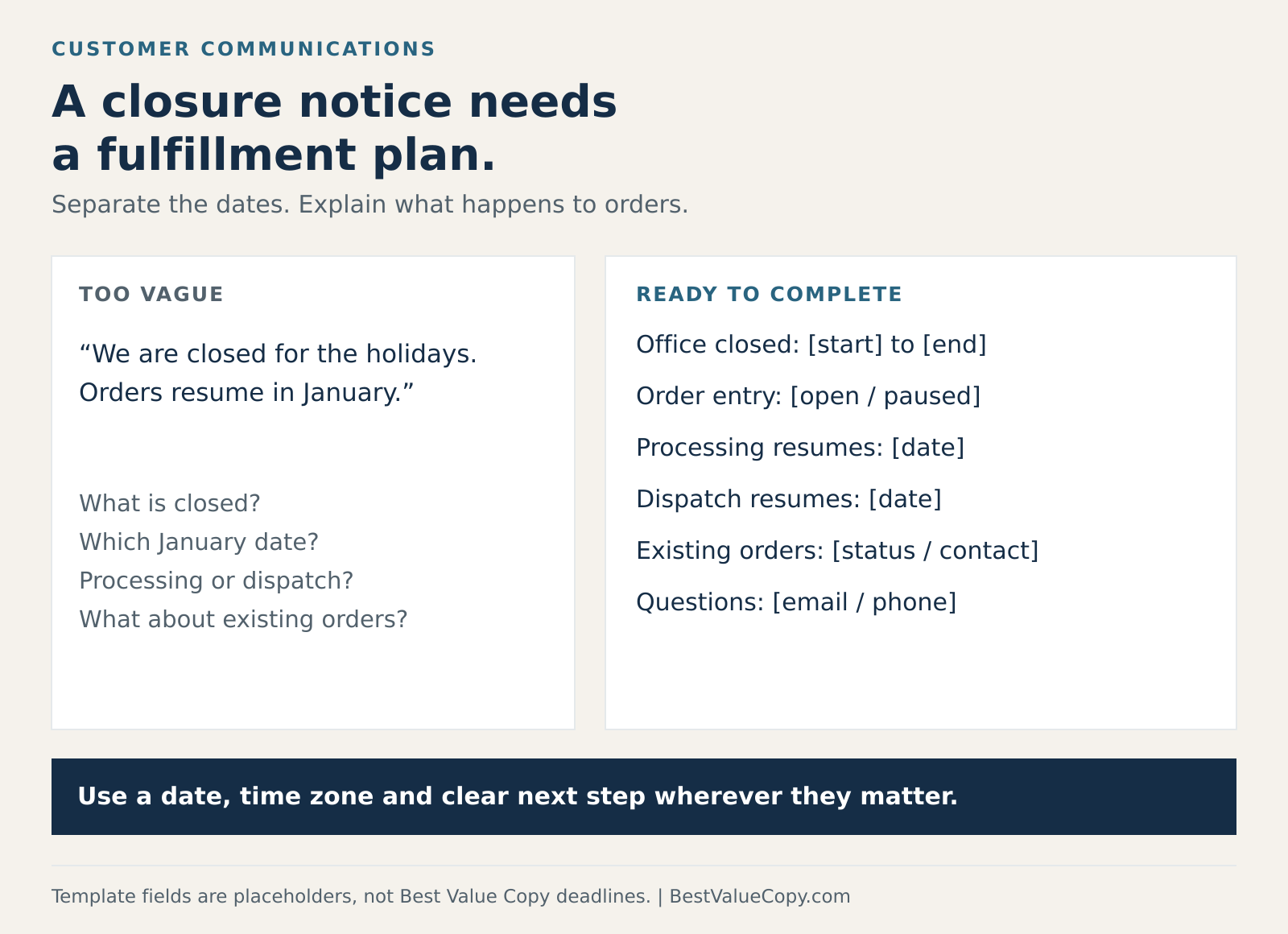
A holiday closure notice should tell customers which services will stop, when they will restart, and what will happen to new and existing orders. A sign that says “Closed for the holidays” answers only one of those questions.
For a manufacturer, the office may reopen before production restarts. For a wholesaler, a purchase order received before the break may still need quantities, credit approval, or an accepted dispatch date. For a retailer, an online checkout can remain open while fulfillment is paused.
Use these 12 original templates to communicate those differences clearly. They cover holiday hours, manufacturing shutdowns, order and approval deadlines, warehouse appointments, affected orders, and January replenishment. Every template appears in full on this page, ready to copy and customize. The 2026 carrier note is separate from the reusable templates.
Start with what you need: Choose a notice, read the 12 templates, or review the before-you-send checklist.
Published by Best Value Copy. These are adaptable editorial templates, not a statement of Best Value Copy's holiday schedule or ordering terms. Replace every bracketed field, remove instructions and inapplicable sentences, and have the person responsible for operations approve the final wording.
How to use these notice templates
- Choose your situation. Use the guide below to find the relevant notice. Each example includes a suggested audience, timing, and format.
- Copy the example text. Select the subject or heading and the message inside the indented example, then copy and paste it into your email, document, or website editor. On a phone, touch and hold the text, adjust the selection, and tap Copy.
- Customize the details. Replace every bracketed field with your approved dates, service details, order requirements, and contact information. Remove any sentences that do not apply.
- Review before publishing. Work through the checklist near the end of this article and confirm that every channel uses the same operating schedule.
What should a holiday closure notice include?
At minimum, identify the affected location or service, the closure period, the reopening date and time zone, the handling of orders received during the break, and a reliable contact. If production, processing, pickup, or dispatch follows a different calendar, give each its own date.
Before writing, agree on one operating schedule shared by sales, customer service, production, and fulfillment. A useful notice begins with approved facts, not a festive greeting.
- Scope: Which office, warehouse, product line, or service is affected?
- Customer action: Must the buyer submit a complete PO, approve a proof, book collection, or simply note the hours?
- Deadline: What date, time, time zone, and submission channel apply?
- Order status: Is an order only received, or has it been accepted with a confirmed schedule?
- Exceptions: How are accepted orders, incomplete POs, open quotes, backorders, and urgent requests handled?
- Restart: When do message review, production, pickup, and dispatch each resume?
- Owner: Who can answer questions, and when will the customer receive another update?
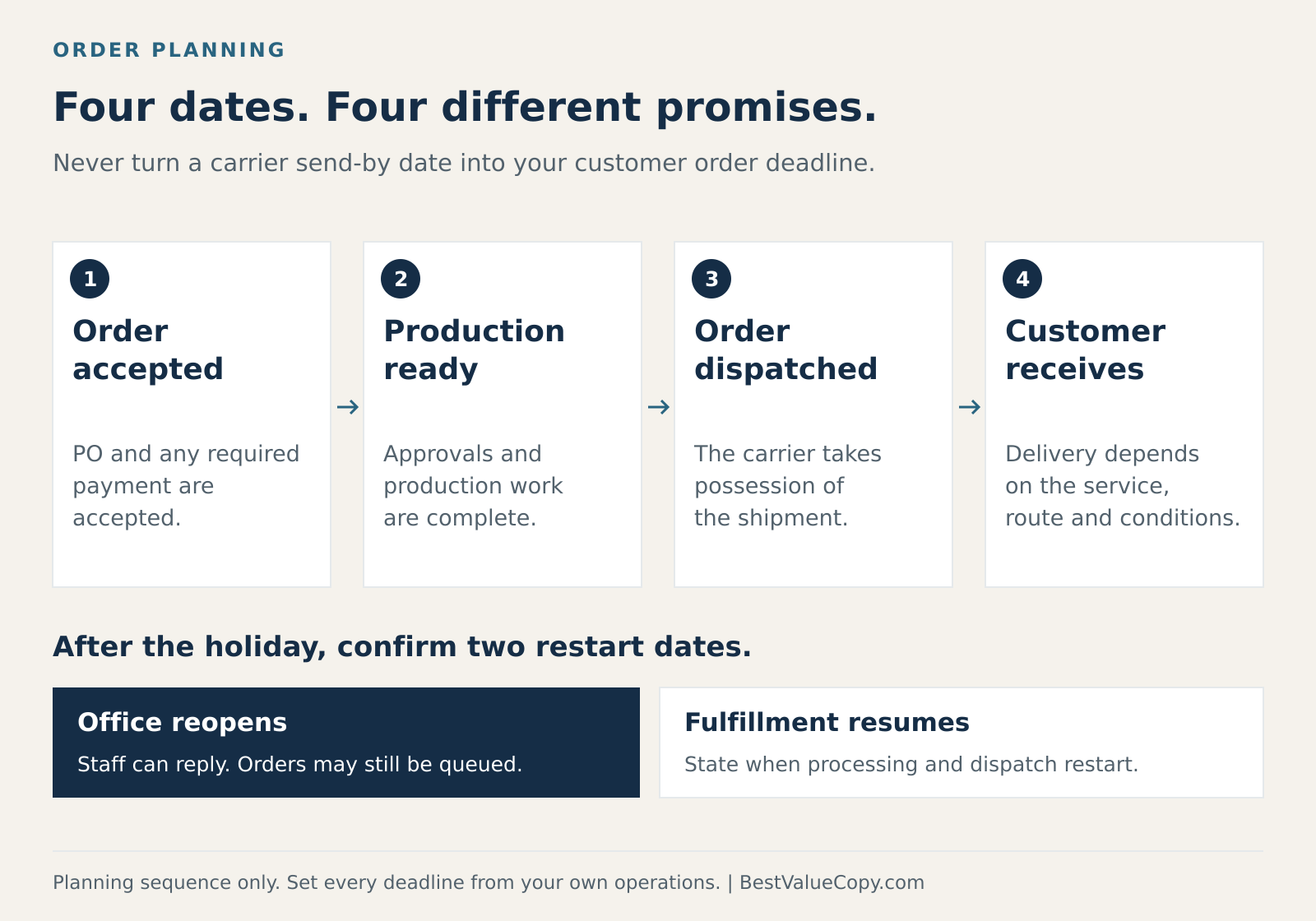
Separate the order deadline from the shipping deadline
An order deadline is the last point at which a business can accept the required information and prerequisites for a particular schedule. A dispatch cutoff is the last planned handoff to a carrier. Neither is automatically the customer's delivery date.
Work backward from the customer's required receipt date. Check destination-specific transit and carrier acceptance, then allow for packing, production, approvals, and order review. Count the business's actual working days and capacity. Add a buffer that operations can justify; there is no universal number of days that works for every order.
| Milestone | What it means | What to confirm |
|---|---|---|
| Order accepted | The business has accepted the order under its terms. | Complete PO, quantities, account requirements, and acknowledgement. |
| Production complete | The goods or printed materials are ready for the next step. | Materials, capacity, final approvals, finishing, and packing. |
| Dispatched | The shipment has been handed to the carrier. | Pickup schedule, service, destination, and tracking or acceptance. |
| Received | The customer receives the goods. | Delivery estimate, receiving hours, appointments, and exceptions. |
Planning example: A buyer submits a PO before your closure. If the order still lacks approved specifications, that submission may not meet your published complete-order deadline. Tell the buyer what is missing and how the schedule will be confirmed. Do not silently convert a requested delivery date into a promise.
A 2026 carrier reference, not your business's order cutoff
USPS lists December 17, 2026 for Ground Advantage and First-Class Mail, December 18 for Priority Mail, and December 19 for Priority Mail Express as recommended send-by dates for expected delivery before December 25 in the contiguous United States. Actual delivery can vary with origin, destination, acceptance time, and other conditions. Consult the official USPS 2026 holiday shipping guidance for other destinations and services.
Those dates concern mailing or shipping, not when a customer should place a manufacturing, wholesale, retail, or printing order. Your own cutoff may be substantially earlier. Do not use these dates to promise a Best Value Copy delivery date; confirm the selected job's production and shipping requirements before ordering.
Choose the notice your customer needs
Send the message that matches the decision the reader must make. A general closure announcement does not replace an individual update about an accepted order.
| Situation | Template | Main recipient and channel |
|---|---|---|
| Location or service closes | 1. Holiday closure | Customers; email, website, entrance notice. |
| Factory pauses production | 2. Manufacturing shutdown | Buyers and account contacts; direct email or letter. |
| A complete wholesale PO is due | 3. Purchase-order cutoff | Purchasing teams; buyer email and current insert. |
| Approval is still needed | 4. Production and approval | Order approver; order-specific email. |
| Shipping window is closing | 5. Shipping announcement | Shoppers and buyers; website, checkout, email. |
| Warehouse hours change | 6. Pickup and receiving | Customers and carriers; appointments and signs. |
| An accepted order needs clarity | 7. Open-order status | Affected buyer; individual email. |
| An item is unavailable | 8. Backorder update | Affected buyer; direct contact. |
| A real deadline is approaching | 9. Final reminder | Buyers with unfinished actions; targeted email. |
| The team is unavailable | 10. Automatic reply | Incoming contacts; email response. |
| Operations resume | 11. Reopening and dispatch | Customers and queued orders; website and email. |
| Accounts need replenishment | 12. January reorder | Existing buyers; account email and current line sheet. |
12 copy-ready holiday notice templates
The bracketed fields are intentional editing prompts. Use full dates with the year and time zone wherever timing matters. The instructions beside each template are for your team; the example text is the part to adapt for customers. The timing suggestions below are planning guidance, not fixed industry deadlines.
1. Holiday closure notice
Purpose: Tell customers exactly which service is closing and when it returns.
Who should use it: Retailers, offices, distributors, and businesses with customer-facing locations.
When to send: After the closure schedule is approved; repeat before the last normal service day.
Best format: Customer email plus a website notice; a door or counter notice for visitors.
Print support: Print a short, high-contrast notice at each affected entrance and collection counter. Remove it when normal service returns.
Subject or heading: Holiday hours for [Company name]: [closure dates]
Hello [Customer name],
Our [location or service] will be closed from [weekday, month day, year, time and time zone] through [weekday, month day, year]. We will reopen on [weekday, month day, year] at [time and time zone].
During the closure, [state whether online orders can be submitted and whether anyone will review them]. The first day we expect to process new requests is [date]. Dispatch will resume on [date], subject to each order's confirmation.
If you have an order already in progress, refer to your latest order confirmation or contact [name/team and email/phone] by [date and time]. For [specific urgent issue], use [monitored contact and hours].
Thank you for planning with us. [Company name]
Before sending: Name the affected location or service; distinguish reopening, processing, and dispatch. If no urgent service exists, replace that sentence with 'No urgent support is available during this closure.'
2. Manufacturing shutdown notice
Purpose: Help buyers plan around a production pause without implying every order will ship before it.
Who should use it: Manufacturers, fabricators, and made-to-order suppliers.
When to send: Before the longest affected lead time reaches the shutdown; contact open-order customers individually.
Best format: Account-specific email or letter, supported by a general schedule notice.
Print support: Include the approved schedule in representative folders or outgoing shipments while it remains useful. Keep order-specific commitments in the account correspondence.
Subject or heading: Production pause at [facility]: planning your [holiday/year-end] orders
Dear [Buyer name],
Production at [facility or product line] will pause after [date/time/time zone] and is scheduled to restart on [date]. Our customer service team will [availability], and our warehouse will [separate dispatch/receiving schedule].
For orders needed before the pause, send your purchase order, quantities, specifications, and required receipt date to [contact] by [planning date]. This planning date is not an automatic acceptance or delivery commitment. We will confirm material availability, capacity, approvals, and the proposed schedule for each order.
For accepted orders, [account contact] will confirm any affected production or dispatch dates directly. For open quote [reference], production capacity is [verified status]; its validity and reservation terms are [applicable conditions]. Orders received during the pause will [approved handling rule].
Please tell us about your own receiving closure or critical replenishment needs so we can review the schedule together. [Name, role, company, contact]
Before sending: Verify the facility, products, open orders, restart capacity, customer service, and warehouse calendars separately.
3. Wholesale purchase-order cutoff
Purpose: Define what a complete order must contain before the holiday allocation or processing cutoff.
Who should use it: Wholesalers, distributors, account managers, and purchasing teams.
When to send: Before the cutoff with enough time for buyers to correct incomplete orders.
Best format: Buyer email with an order checklist; a current insert for account packets.
Print support: Use a dated one-page insert alongside the current line sheet. Avoid printing a changing stock position on a long-life catalog.
Subject or heading: Wholesale order deadline: complete POs due [date]
Hello [Buyer name],
To request [dispatch window or allocation period], please submit a complete purchase order by [date, time and time zone] to [order channel]. Include your account and PO numbers, product codes, variants, case quantities, delivery address, and requested receipt date.
The applicable minimum order and case-pack requirements are [current requirements or current terms URL]. Please confirm [credit approval, deposit, or other applicable prerequisite] before the cutoff. We will contact you if information is missing; submission alone does not confirm acceptance or a dispatch slot.
We will acknowledge the accepted quantities and schedule in [confirmation method]. Existing accepted orders remain subject to their agreed terms. Open quotes remain subject to their stated validity and conditions; ask [account contact] to confirm availability before issuing a PO.
Orders completed after the cutoff will [approved review or scheduling rule]. Questions about a partial shipment or an urgent shortage should go to [contact]. [Company name]
Before sending: Specify the acceptance step, current case quantities, prerequisites, and treatment of late or incomplete POs.
4. Production and approval deadline
Purpose: Prevent a submitted order from being mistaken for a job that is ready for production.
Who should use it: Custom-product businesses and suppliers requiring proofs, specifications, or artwork approval.
When to send: When the job is quoted or scheduled, with a reminder before approval is due.
Best format: Order-specific email with an approval checklist.
Print support: A checklist can support a job packet, but send approval requests digitally so the latest version and response are traceable.
Subject or heading: Action needed for order [order number]: approval due [date]
Hello [Customer name],
Your requested [dispatch or completion] date is [date]. To keep the proposed production schedule, we need the following by [date, time and time zone]: [approved proof/specification version], [final quantities], and [payment or other prerequisite, if applicable].
Please approve through [approved channel] and identify [version or reference]. A reply to an older proof may require clarification. Changes after approval may require a revised quote and schedule.
If the complete approval package arrives after the deadline, we will review the next available production slot and confirm a revised date before proceeding under the applicable order terms. We cannot treat the original requested date as confirmed solely because the order was submitted.
For questions about the approval, contact [name and contact]. [Company name]
Before sending: Use the business's actual approval workflow. This is a neutral template, not Best Value Copy's ordering policy.
5. Customer shipping deadline announcement
Purpose: Explain a business ordering cutoff without turning a carrier recommendation into a delivery promise.
Who should use it: Ecommerce sellers, wholesalers, and businesses shipping physical products.
When to send: After the business verifies its own stock, processing calendar, carrier services, and destinations.
Best format: Website and checkout notice plus customer email; product-specific wording where lead times differ.
Print support: Use a short insert for repeat customers only while the cutoff is current. Link to the maintained schedule and print its revision date.
Subject or heading: Planning for [occasion]: order and shipping information
For [eligible in-stock products and destinations], place a complete order by [date, time and time zone] for our planned dispatch by [date]. Orders requiring [custom production, approval, or other extra work] have a separate deadline: [date or contact instruction].
Our order cutoff includes our own processing time. Carrier send-by recommendations apply to parcels handed to the carrier; they are not our order deadline. Delivery estimates depend on the service, destination, acceptance time, and operating conditions.
Check [current shipping information URL] for available services and any exclusions. If you need delivery for a specific event, contact [team] before ordering so we can review the available options. [Company name]
Before sending: State eligible products and regions; separate ordering, dispatch, and estimated receipt. Never add a guarantee the business has not approved.
6. Warehouse pickup and receiving notice
Purpose: Prevent unsuccessful collections and deliveries when the warehouse schedule differs from office hours.
Who should use it: Distributors, manufacturers, wholesalers, and businesses with appointment-based collection.
When to send: Before appointments are booked; confirm the change directly with scheduled customers and carriers.
Best format: Appointment email plus a warehouse entrance or collection-counter notice.
Print support: Post a clear notice at the correct entrance. Use separate pickup and receiving headings if the hours differ.
Subject or heading: [Location] holiday pickup and receiving schedule
Customer pickups at [warehouse address] will end at [time/time zone] on [date] and resume on [date/time]. Incoming deliveries will be accepted through [date/time] and resume on [date/time].
Pickup requires [appointment or release-confirmation procedure]. Please wait for confirmation that your order is ready before arriving. Drivers should use [entrance or check-in instructions].
If you have an appointment during the affected period, contact [dispatch team and contact] to arrange a confirmed alternative. Office reopening on [date] does not by itself mean the warehouse is accepting collections or deliveries. [Company name]
Before sending: Reconcile the public notice with appointment records and carrier instructions; confirm physical access arrangements.
7. Open-order status before closure
Purpose: Give a specific buyer a reliable status instead of making them interpret a general closure announcement.
Who should use it: Account managers and customer-service teams handling accepted orders.
When to send: After checking the order record, before the customer loses access to normal support.
Best format: Individual account email or letter, with a copy in the order record.
Print support: Print only for the account's document workflow or shipment pack; do not use a public sign for customer-specific information.
Subject or heading: Status of PO [PO number] before our [date] closure
Dear [Buyer name],
We reviewed your accepted order [order number], PO [PO number], on [date]. The current status is [specific status]. The [confirmed/estimated] dispatch date is [date].
[State whether the closure affects this order and explain any proposed schedule change.] The next action is [action], owned by [person/team], due [date]. If a change requires your approval under the order terms, please respond through [channel].
The latest shipment or collection information will be provided by [method]. During the closure, [state actual support availability]. Your next planned update is [date], even if there is no change in status.
Thank you, [name, role, company, contact].
Before sending: Verify the order record and label estimates clearly. This notice does not itself amend accepted terms.
8. Backorder or availability update
Purpose: Help a buyer choose what to do when a shortage overlaps a holiday closure.
Who should use it: Manufacturers, distributors, and retailers with affected customer orders.
When to send: As soon as an affected order is identified; provide a definite next-update date.
Best format: Direct buyer email or telephone follow-up documented by email.
Print support: Avoid mass printing volatile availability. If an insert is needed, direct readers to current status rather than freezing an uncertain replenishment date.
Subject or heading: Availability update for [product/code] on order [number]
Hello [Customer name],
We are contacting you about [quantity and product/code] on [order/PO number]. The item is currently [backordered or unavailable]. Our current replenishment estimate is [date or 'not yet confirmed']; holiday operating changes may affect the next dispatch opportunity.
The options available under your order terms are [verified options, such as waiting, an approved alternative, or a partial shipment]. Before any partial shipment, we will confirm quantities, additional freight if applicable, and your authorization. We will not substitute a product without the required approval.
Please contact [name/channel] by [response date, if genuinely needed] with your preference. If no reply is received, [approved handling rule]. We will update you again by [date], even if the estimate has not changed.
We appreciate the opportunity to help you plan. [Company name]
Before sending: Offer only available options and applicable remedies. Do not imply a general template overrides a customer's rights or contract.
9. Final order-deadline reminder
Purpose: Prompt a clear action before a real cutoff, without artificial urgency.
Who should use it: Known buyers who have not completed an order or approval.
When to send: Shortly before the verified deadline, allowing time to act; suppress recipients who already completed it.
Best format: Short targeted email or account message; a compact counter notice if relevant.
Print support: Use existing notices or a small updated insert. A new print run is unnecessary if the deadline is too close for the piece to reach readers.
Subject or heading: Reminder: [required action] due [date/time]
Hello [Customer name],
A reminder that [complete PO, approved proof, or other action] is due by [date, time and time zone] to request [specific production or dispatch window]. Submit it through [channel].
We still need [specific missing item]. If you have already sent it, please share the reference so [contact] can check it. Your schedule is confirmed only through [normal confirmation process].
After the cutoff, [approved next-window rule]. If your needs have changed, let [contact] know so we can review the available options. [Company name]
Before sending: Do not describe unverified capacity as available or imply that a reminder reserves stock.
10. During-closure automatic reply
Purpose: Set a realistic response expectation and route genuinely urgent issues.
Who should use it: Customer-service mailboxes, account managers, and order desks.
When to send: Activate when coverage changes; disable or update when normal coverage resumes.
Best format: Automatic email response plus a matching contact-page notice.
Print support: No new print piece is usually needed; keep posted hours consistent with the message.
Subject or heading: Your message to [Company name]: holiday response schedule
Thank you for contacting [Company name]. Our [team] is unavailable from [date/time/time zone] through [date]. We expect to begin reviewing messages on [date]; [state realistic response expectation or explain that timing will be confirmed].
This automatic reply confirms receipt of your message, not acceptance of an order, a production slot, or a delivery commitment. For an existing order, include [order/PO number] so we can locate the record.
For [specific urgent issue], contact [monitored channel and coverage hours]. For current operating dates, see [schedule URL]. [Company name]
Before sending: If no urgent service exists, replace that sentence with 'No urgent support is available during this closure.' Avoid a fixed response-time promise unless staffing supports it.
11. Reopening and dispatch-resumption notice
Purpose: Explain what has resumed and how queued orders will be handled.
Who should use it: Businesses returning from a holiday or production shutdown.
When to send: When operations actually resume; update customers if the planned restart changes.
Best format: Website notice and customer email, with direct updates for affected orders.
Print support: Replace closure signs promptly. A short counter notice can explain temporary collection hours while the queue clears.
Subject or heading: [Company name] is reopening: order processing and dispatch update
Our [office/service] has reopened as of [date/time/time zone]. Order processing resumes on [date], production on [date], and dispatch on [date]. [State any product-line or location exceptions.]
Orders and requests received during the closure will be reviewed according to [approved queue or priority policy]. We will confirm individual production or dispatch dates through [method]. Reopening does not mean every queued order will leave today.
If your required receipt date or delivery address has changed, send [order/PO number and updated information] to [contact]. Customers whose confirmed schedules are affected will receive a direct update.
Thank you for your patience and for working with us. [Company name]
Before sending: Confirm actual operating readiness and each restart date before changing the message from planned to resumed.
12. January replenishment reminder
Purpose: Help existing accounts plan their first post-holiday replenishment order.
Who should use it: Wholesale account teams, distributors, and repeat-order suppliers.
When to send: When current stock, lead times, and ordering documents are confirmed for the new period.
Best format: Personalized buyer email with the current line sheet or ordering link.
Print support: Include a dated reorder insert with current shipments or an updated line sheet. Print a catalog only when the product-range content warrants it.
Subject or heading: Planning your January [year] replenishment order
Hello [Buyer name],
As you review [product category] after the holiday period, we can help plan your next replenishment order. Our current ordering document is [document name/version and URL], effective [date]. It lists [relevant product codes, case quantities, and current ordering information].
Please send your proposed quantities and required receipt date to [contact]. Current lead times are [verified lead-time information or instruction to request confirmation]; we will confirm availability and dispatch timing for your order.
If your account requires a new PO, updated delivery instructions, or an approval before replenishment, include those details. Any price or terms change should be handled through the applicable agreement and a separate clear notice; this reminder does not change accepted orders.
Thank you for your business. [Name, role, company, contact]
Before sending: Check the document version and current terms. For price changes, review the applicable agreement and seek appropriate professional guidance where needed.
When should you send each notice?
Start with the longest affected lead time. A manufacturer with lengthy approvals needs a different communication schedule from a shop closing for one afternoon. The following sequence is adaptable; it does not prescribe fixed lead times.
- When the operating calendar is approved: Tell account teams, identify affected orders, and prepare the main closure or shutdown announcement.
- Before the buyer's last workable ordering point: Send the complete-order requirements, product exceptions, and submission route. Give buyers time to resolve missing information.
- Before the cutoff: Remind only customers with an unfinished action. Confirm affected accepted orders individually.
- At closure: Activate the automatic reply and match the website, checkout, voicemail, signs, and customer-service wording.
- At restart: Confirm which functions have resumed. Replace closure signs, update queued orders, and remove expired urgency.
- After stock and lead times are confirmed: Offer existing accounts a useful replenishment reminder using current ordering documents.
Which customer notices are worth printing?
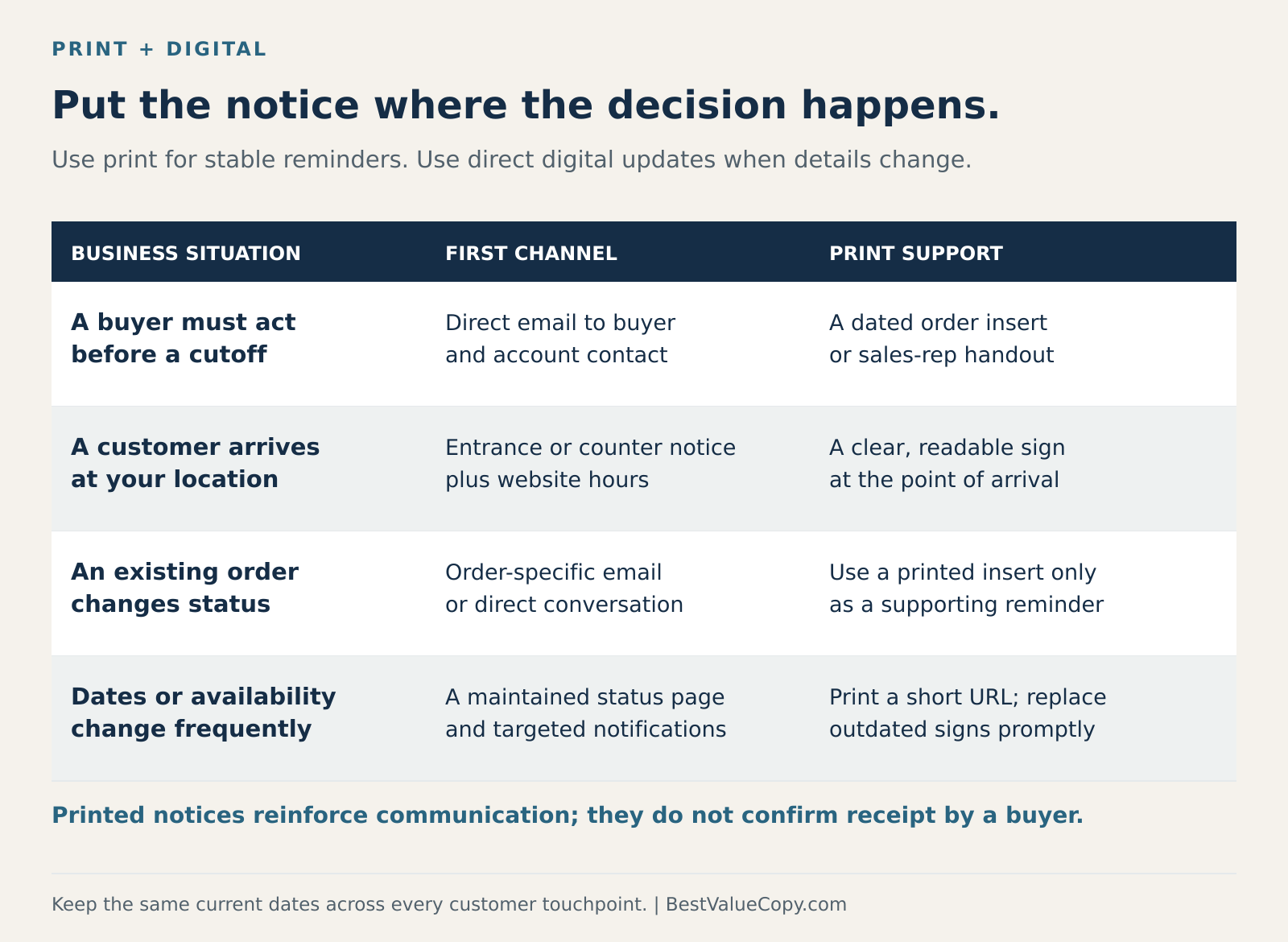
Print is most useful when a customer needs stable information at a physical point of decision: an entrance, collection counter, representative meeting, or opened shipment. Email and direct account contact are better suited to changing order details and requests that need a response.
| Customer task | Primary channel | Useful print support |
|---|---|---|
| Check opening or collection hours | Current website and appointment message. | Indoor entrance or counter notice with readable dates. |
| Place a complete wholesale order | Buyer email and current ordering document. | Dated cutoff insert beside the line sheet. |
| Approve a schedule change | Individual account correspondence. | Letter on company letterhead if the account workflow calls for it. |
| Track an uncertain backorder | Direct update with a next-update date. | Usually none; a printed estimate can become obsolete quickly. |
| Prepare a replenishment order | Current stock, lead-time, and ordering information. | Updated line sheet or shipment insert; catalog only when the range needs it. |
Printing a closure sheet or order-cutoff insert? Explore Best Value Copy's flyer printing options for one- or two-sided notices in color or black and white. Choose the available size and stock for where the piece will be used, then check the configured job details.
For account communications that call for a formal printed letter, review custom letterhead printing. Use your own business identity on the notice; Best Value Copy is the printer and the publisher of this resource.
A notice about a deadline serves a different purpose from a product catalog. If you are also updating buyer materials, read the guide to wholesale catalogs, line sheets, and sell sheets to choose the appropriate format. For a multi-page product-range update, compare catalog printing options.
Prepare a notice that is easy to read and easy to replace
- Make the required action and date the most prominent information. Use dark text on a light background and generous spacing.
- Include the year, location, time zone, and a short revision date where multiple versions may circulate.
- For a door notice, shorten the full email to the essential hours and next step. Check legibility at the actual viewing distance.
- Keep volatile stock information online. If you add a QR code, include a readable URL and test the printed code with more than one phone.
- After placing your customized wording in a document or design, export a PDF at the intended finished size, review every page, and check the selected product's file and bleed requirements. These text examples do not set a print size, margin, or bleed.
- Allow for preparation, approval, printing, and delivery before the notice must reach its audience. Production time and shipping time are separate.
Check these details before you send or print
Review this checklist with the person responsible for operations before publishing your message. You can also copy it into your team's working document.
- Every date matches the approved operating calendar, including the weekday, year, and time zone.
- The notice explains what a complete order requires and how acceptance is confirmed.
- Existing orders and open quotations receive the treatment required by their terms; a general announcement does not rewrite them.
- Office hours, production, dispatch, pickup, and receiving dates are separated where necessary.
- Estimated dates are labeled as estimates. Carrier guidance has not become an unsupported delivery promise.
- The contact route is staffed as described, with a next-update date for unresolved orders.
- All bracketed fields and editorial instructions have been removed from the customer version.
- The email, website, checkout message, automatic reply, and printed notice use the same approved facts.
- Someone owns removal of expired signs, replacement of outdated inserts, and the reopening update.
Questions about holiday customer notices
How can I use these templates in an email or printed notice?
Copy the subject or heading and message from the example you need, then paste them into your own email or document. Replace the bracketed fields and remove any wording that does not match your operation. For a printed notice, add your business name and branding, make the dates prominent, and check the final layout before ordering.
Can a business keep taking online orders while it is closed?
It can communicate that orders may be submitted while processing is paused, if that matches its actual operation. Explain the delay before purchase and in the confirmation. State when review begins and how a dispatch date will be confirmed. An automatic receipt should not suggest that a production slot has been accepted if it has not.
Should every customer receive the same notice?
A general schedule can be shared widely, but affected accepted orders need individual attention. Segment by location, product lead time, destination, account requirements, and unfinished actions where those differences change what a buyer must do.
What if the reopening date changes after notices are sent?
Update the maintained online schedule first, contact affected customers directly, and replace physical signs. Identify what changed and when the next update will arrive. Keep the old version in your internal records so customer service can understand what recipients were previously told.
Should a price increase be included in a holiday closure notice?
Usually it deserves a separate notice with its own effective date, affected items, and account-specific terms. Combining it with hours information can obscure an important commercial change. Review the applicable agreement and obtain appropriate professional guidance when needed; do not imply that accepted orders or contracts can automatically be changed.
How should notices work across several locations or time zones?
Name the location and time zone next to each deadline. Use a separate schedule or clearly labeled section when sites differ. Avoid a company-wide “we reopen Monday” message if production, sales, and distribution centers follow different calendars.
Make the next customer action clear
A strong holiday notice lets the reader answer three practical questions: What changes? What do I need to do? Who will confirm what happens next? Once those answers are approved, carry the same facts into the channels your customers actually use.
Ready to prepare your notices? Choose and copy a template above, customize the wording, and review the before-you-send checklist. When your message is approved, explore printing options for your notices and inserts.


