
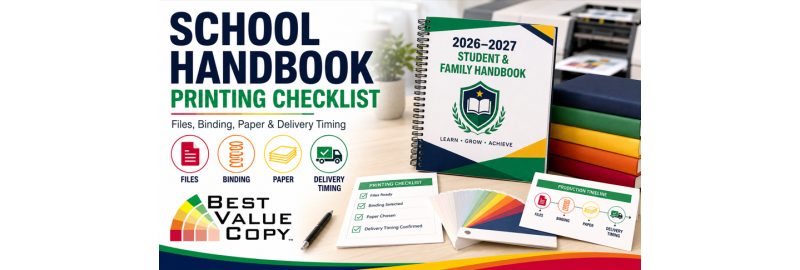
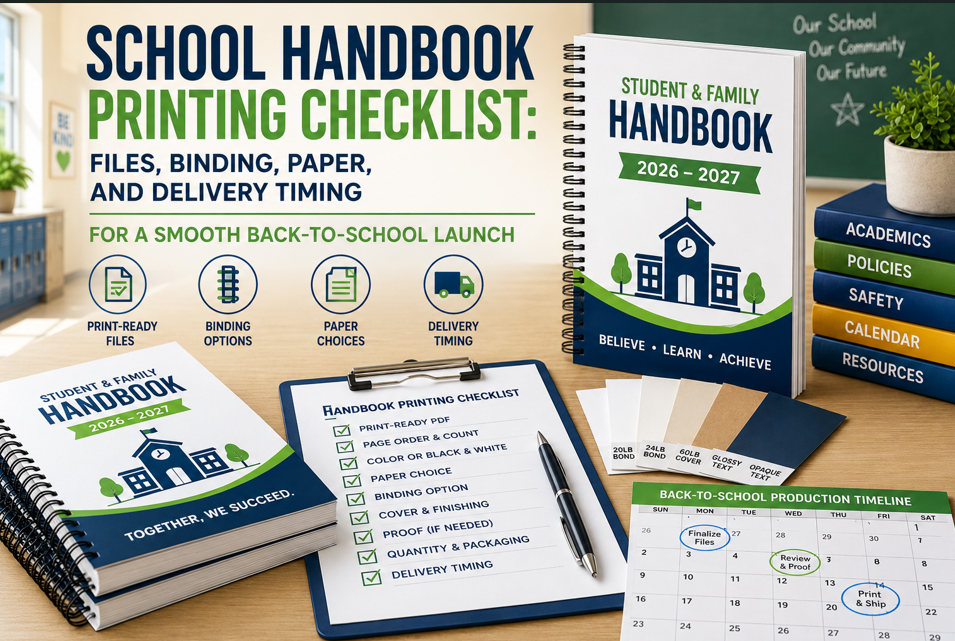
School Handbook Printing Checklist: Files, Binding, Paper, and Delivery Timing for a Smooth Back-to-School Launch
School handbooks are expected to do a lot.
They introduce policies, explain attendance procedures, outline academic expectations, provide contact information, communicate calendars, and help students and families understand how the school operates.
They also need to be completed during one of the busiest times of the year.
A handbook that reaches the printer with missing pages, inconsistent sizing, an unsuitable binding choice, or an unrealistic delivery date can create unnecessary delays just before school begins. The best way to prevent those problems is to treat printing as part of the handbook project from the beginning, not as the final step after every other decision has been made.
Use this school handbook printing checklist to organize your files, select paper and binding options, and build a realistic production schedule for a smoother back-to-school launch.
Start With the Final Distribution Plan
Before choosing paper or binding, determine how the handbook will be used.
Ask these questions:
-
Will every student receive a personal copy?
-
Will copies be distributed by grade, classroom, campus, or department?
-
Will staff members receive a different version?
-
Will the handbook be carried in a backpack throughout the school year?
-
Will families be expected to sign and return a page?
-
Will the handbook double as a planner, reference manual, or policy guide?
-
Will additional copies be needed for enrollment packets or new students?
-
Does the school need copies grouped or packaged in specific quantities?
The answers influence nearly every printing decision.
A short handbook distributed at orientation may work well as a saddle-stitched booklet. A larger policy manual that will be used throughout the year may be better suited to plastic coil, comb, wire, tape, velo, or perfect binding.
Best Value Copy offers manual and booklet printing with multiple finished sizes, paper stocks, cover choices, stapling options, binding styles, drilling, shrink wrapping, and paper proofs. These options make it possible to configure the handbook around the school’s actual use rather than forcing every project into the same format. (Best Value Copy)
Part 1: Prepare the Handbook File Correctly
A clean, organized PDF is one of the most important parts of a successful handbook order.
Best Value Copy’s manual and booklet ordering systems are designed around page count, finished size, color selection, printing sides, paper, binding, covers, and other production choices. Double-sided printing counts the front and back as two pages, so the number of PDF pages should correspond with the way the order is configured. (Best Value Copy)
Confirm the final page size
Choose the finished handbook size before the layout is completed.
Common handbook formats include:
-
8.5 by 11 inches for a traditional full-size handbook
-
5.5 by 8.5 inches for a compact booklet
-
6 by 9 inches for a smaller manual-style format
Best Value Copy’s manual and booklet products currently include several finished sizes, including 8.5 by 11, 8.5 by 14, 11 by 17, 6 by 9, 5.5 by 8.5, 5 by 7, and 4 by 6 inches. (Best Value Copy)
The size selected when ordering should match the size of the PDF. Avoid designing the document at one size and expecting it to be automatically resized at production. Scaling can affect font size, margins, images, page numbers, and the amount of space available near the binding.
Build the PDF in normal reading order
Unless a printer specifically requests imposed spreads, handbook pages should generally appear in normal reading order:
-
Front cover
-
Inside front cover or first interior page
-
Remaining interior pages
-
Inside back cover
-
Back cover
Do not manually pair the first and last pages together or arrange the document into printer spreads.
Best Value Copy uses the first page or first two pages of the uploaded PDF for the front cover when a printed cover is selected, depending on whether that cover is configured as single-sided or double-sided. The last page or last two pages are used for the back cover in the same manner. (Best Value Copy)
Before uploading, confirm:
-
The front cover is in the correct position.
-
The back cover is in the correct position.
-
Pages are not duplicated.
-
No pages are missing.
-
Blank pages are intentional.
-
Every page has the same dimensions.
-
The PDF page count matches the order.
-
Portrait and landscape pages have not been mixed accidentally.
Leave enough room for the binding
The inside margin deserves special attention.
Text, page numbers, tables, signature lines, and important graphics should not sit too close to the edge that will be bound. A handbook may look balanced on a screen but become difficult to read when content falls into the binding area.
The amount of space needed depends on the binding style and the thickness of the finished document. Coil-, comb-, wire-, and tape-bound documents usually require visible clearance near the punched or bound edge. Perfect-bound books may need a more generous interior margin because the pages do not open completely flat.
A safe workflow is to select the likely binding before the design is finalized, then review several interior pages at actual size.
Check links, QR codes, forms, and signature pages
School handbooks frequently contain interactive or action-oriented content.
Review:
-
Website addresses
-
Staff email addresses
-
Phone numbers
-
QR codes
-
Emergency contacts
-
Transportation information
-
Attendance procedures
-
Calendars
-
Bell schedules
-
Permission forms
-
Student and parent acknowledgment pages
-
Signature lines
-
Return-by dates
Print a test copy on an office printer and scan every QR code from the printed sheet. Something that works from a monitor may be too small, too faint, or too close to surrounding elements once printed.
Use high-quality images and logos
Avoid placing small website images, screenshots, or heavily compressed graphics into the handbook.
Use original, high-resolution versions of:
-
School logos
-
District seals
-
Campus photographs
-
Maps
-
Mascots
-
Sponsor logos
-
Diagrams
-
Safety illustrations
Full-page photographs and covers require especially strong image quality because enlargement makes pixelation more noticeable.
Add bleed when artwork reaches the edge
Choose the bleed option when colors, photographs, or graphics are intended to print all the way to the finished edge.
Best Value Copy’s manual and booklet products include a bleed selection identified as printing to the edge of the page. (Best Value Copy)
Turning on bleed during ordering does not automatically extend the artwork. The backgrounds and images in the PDF must already continue beyond the trim line.
Keep names, text, page numbers, logos, and other essential information safely inside the finished edge.
Part 2: Choose Color or Black-and-White Printing
Best Value Copy allows manual and booklet orders to be configured in color or black and white. For jobs containing a combination of color and black-and-white pages, its product instructions direct customers to request a custom quote. (Best Value Copy)
The right choice depends on the handbook’s content and budget.
Black-and-white printing may work well for:
-
Policy-heavy handbooks
-
Staff manuals
-
Text-focused reference guides
-
Large quantities with limited color content
-
Documents that use simple charts and line illustrations
Color printing may be more effective for:
-
Younger student audiences
-
Branded district publications
-
Campus maps
-
Color-coded sections
-
Safety diagrams
-
Calendars
-
Programs with photographs
-
Handbooks that also serve as recruitment or community materials
Color does not need to appear on every page to make a handbook easier to navigate. A color cover, section dividers, or selected visual pages may provide enough visual organization. Because mixed color and black-and-white production may require a custom quote, determine that approach before the final file is submitted.
Part 3: Select the Right Paper
Paper affects the handbook’s cost, thickness, durability, readability, and overall feel.
Best Value Copy currently lists bond, opaque text, glossy text, cover, index, and coated cover stocks across its manual and booklet configurations. Its product guidance identifies 20-pound paper as the standard choice for many jobs and notes that heavier paper reduces show-through and creates a more substantial feel. (Best Value Copy)
20-pound white bond
This is a practical choice for many text-heavy handbooks.
Consider it when:
-
The handbook contains many pages.
-
Cost and overall weight are priorities.
-
Most pages contain text rather than large photographs.
-
The document will be distributed in high quantities.
Best Value Copy describes 20-pound paper as appropriate for most standard jobs unless there is a specific need for a specialty or heavier stock. (Best Value Copy)
Heavier bond or opaque text paper
A heavier interior sheet may be useful when:
-
The handbook is printed double-sided.
-
The design contains dark blocks or photographs.
-
Less show-through is desired.
-
The school wants a more substantial feel.
-
The handbook will be handled throughout the year.
Heavier paper increases the thickness and weight of the finished handbook, so confirm that it remains compatible with the selected binding.
Glossy text paper
Glossy paper can make photographs and bright graphics appear more polished, but it may not be the best choice for a handbook that students or parents need to write in.
Use it selectively for:
-
Image-heavy handbooks
-
Promotional school publications
-
Campus guides
-
Annual program books
-
Covers or special inserts
Cover stock
A heavier cover helps the handbook withstand backpacks, desks, lockers, meetings, and repeated handling.
Best Value Copy’s available cover-related options include printed hard paper covers, clear or vinyl protective covers, cover stocks, and lamination. Some cover options depend on the selected binding. For example, the manual-printing page notes that clear or vinyl covers are not available with perfect binding. (Best Value Copy)
Practical cover choices may include:
-
A heavier printed paper cover for a traditional handbook
-
A laminated printed cover for additional protection
-
A clear plastic front over a printed title page
-
A durable back cover for coil-, comb-, or wire-bound manuals
-
A self-cover for a shorter saddle-stitched booklet
Part 4: Match the Binding to the Handbook
Best Value Copy currently offers saddle stitching as well as comb, plastic coil, wire, perfect, velo, and tape binding for booklet and manual projects. (Best Value Copy)
Each option creates a different experience.
Saddle stitching
Saddle stitching uses staples through the folded spine.
It is often a good choice for:
-
Shorter handbooks
-
Orientation booklets
-
Compact student guides
-
Temporary or annual publications
-
Projects that need a familiar booklet appearance
Advantages include a clean presentation, lightweight construction, and easy distribution.
Because saddle-stitched documents are created from folded sheets, page count and paper thickness affect what can be produced comfortably. Confirm the final page count before placing the order.
Plastic coil binding
Plastic coil allows pages to turn easily and can remain open on a desk.
It may work well for:
-
Frequently referenced handbooks
-
Staff procedure manuals
-
Teacher guides
-
Student planners
-
Documents that include forms or worksheets
The flexible coil is practical for materials that will be opened repeatedly.
Comb binding
Comb binding offers a traditional manual appearance and can work for:
-
Administrative handbooks
-
Staff manuals
-
Departmental procedures
-
Training documents
-
Reference materials
It also accommodates a substantial range of document thicknesses, subject to the binding capacity available for the selected page count.
Wire binding
Wire binding provides a polished, professional appearance and allows pages to turn easily.
It may be appropriate for:
-
Leadership manuals
-
Staff handbooks
-
Branded school publications
-
Premium program guides
-
Documents used during meetings or training
Perfect binding
Perfect binding creates a squared, book-style spine.
It can be a strong choice for:
-
Larger handbooks
-
Policy books
-
Academic catalogs
-
Curriculum guides
-
Publications intended to resemble a paperback book
The finished document looks polished, but it will not lie as flat as coil- or wire-bound formats. Allow additional interior margin near the spine.
Velo and tape binding
Velo and tape binding can create a clean edge and work well for formal or document-style applications.
They may be considered for:
-
Administrative manuals
-
Official policy documents
-
Reports
-
Accreditation materials
-
Staff reference publications
Three-hole drilling
Best Value Copy also offers three-hole drilling on its manual and booklet product configurations. (Best Value Copy)
This may be useful when the handbook will be:
-
Inserted into a school-provided binder
-
Combined with department-specific materials
-
Updated with replacement pages
-
Distributed as part of a staff training package
Part 5: Decide Whether You Need a Paper Proof
A paper proof allows the school to review a physical sample before the full order is produced.
Best Value Copy offers an optional paper proof for manual and booklet orders and clearly notes that requesting one will delay production. (Best Value Copy)
A proof may be worth considering when:
-
The handbook has a large quantity.
-
Color accuracy is important.
-
The document contains complicated tables.
-
The cover must match district branding.
-
There are multiple folded or bound components.
-
The handbook includes small text.
-
The paper choice has not been used before.
-
Leadership wants to approve a physical copy.
-
The deadline allows time for review and approval.
A proof should not be requested as an afterthought. Include it in the project schedule from the beginning.
When the proof arrives, inspect:
-
Finished size
-
Paper weight
-
Cover appearance
-
Binding
-
Page order
-
Margins
-
Text size
-
Image quality
-
Color
-
QR codes
-
Forms and signature pages
-
Overall usability
Part 6: Build a Realistic Delivery Schedule
Fast production does not eliminate the need for planning.
Best Value Copy states that almost all orders ship within 24 to 48 hours and that its production operation runs around the clock. That is production timing, not a promise that every handbook will arrive one or two days after ordering. Shipping time, proofing, file questions, binding, order size, and the destination still need to be considered. (Best Value Copy)
For a smooth back-to-school launch, work backward from the date the handbooks must be in staff members’ or students’ hands.
Six to eight weeks before distribution
-
Confirm the handbook owner and approval process.
-
Select the finished size.
-
Estimate the quantity.
-
Identify the likely paper and binding.
-
Gather policy updates from every department.
-
Request photography, logos, calendars, and maps.
-
Decide whether a paper proof will be required.
Four to six weeks before distribution
-
Complete the first full draft.
-
Confirm the page count.
-
Review legal, safety, attendance, academic, and communication sections.
-
Test the layout at the intended finished size.
-
Confirm the budget.
-
Obtain a quote if the project requires mixed color, unusual specifications, or other custom production.
Three to four weeks before distribution
-
Complete administrative review.
-
Finalize paper and binding.
-
Verify cover setup.
-
Check page order and margins.
-
Proofread names, dates, phone numbers, website addresses, and policies.
-
Test QR codes from a printed page.
-
Submit a paper proof if one is required.
Two to three weeks before distribution
-
Review and approve the proof.
-
Make only necessary corrections.
-
Export the final PDF.
-
Confirm the exact quantity and shipping address.
-
Place the production order.
-
Include clear instructions in the job-notes field.
Best Value Copy’s product setup includes a job-notes area for specific instructions and comments. (Best Value Copy)
After placing the order
-
Monitor communications in case there is a file question.
-
Track the shipment.
-
Plan where cartons will be received.
-
Assign staff to count and sort the copies.
-
Confirm the distribution method.
-
Reserve extra copies for late enrollment, replacements, and administrative use.
Part 7: Plan Packaging and Distribution
The printing project is not complete when the books leave production.
Best Value Copy’s manual and booklet configurations include shrink wrapping, with an option to specify the number of books in each wrap. (Best Value Copy)
Grouping copies may simplify distribution for:
-
Individual classrooms
-
Grade levels
-
School buildings
-
Departments
-
Orientation sessions
-
Staff meetings
-
Enrollment packets
-
Satellite campuses
Before ordering, calculate quantities by destination.
For example:
-
28 copies per classroom
-
125 copies per grade
-
40 copies per department
-
10 administrative copies
-
50 replacement and new-enrollment copies
Include an overage rather than ordering only the current enrollment count. Handbooks may be damaged, misplaced, added to new-student packets, or needed by staff members who were not included in the initial estimate.
Final School Handbook Printing Checklist
Before submitting the order, confirm the following.
File
-
The handbook is saved as one final PDF.
-
Every page uses the same finished size.
-
Pages appear in normal reading order.
-
The front and back covers are positioned correctly.
-
Blank pages are intentional.
-
The PDF page count matches the order.
-
Fonts display correctly.
-
Images and logos are high resolution.
-
QR codes have been tested from a printed page.
-
Bleed artwork extends beyond the trim.
-
Important content remains away from trim and binding edges.
-
The file has been reviewed at actual print size.
Printing
-
The correct quantity has been calculated.
-
Color or black-and-white printing has been selected.
-
Single- or double-sided printing matches the PDF.
-
The selected page size matches the file.
-
Bleed has been selected when needed.
-
A custom quote has been requested for specifications that do not fit the standard configuration.
Paper and covers
-
The interior paper fits the budget and intended use.
-
The paper is compatible with double-sided printing.
-
The cover is durable enough for the school year.
-
Any laminated or protective cover has been selected.
-
The selected cover works with the chosen binding.
Binding and finishing
-
The binding fits the page count.
-
The binding is appropriate for how the handbook will be used.
-
Interior margins allow room for binding.
-
Three-hole drilling has been selected if needed.
-
Shrink-wrap quantities match the distribution plan.
-
Special instructions have been added to the job notes.
Timing and delivery
-
Internal approvals are complete.
-
A paper proof has been included in the schedule if required.
-
Production and shipping time are both considered.
-
The delivery address is correct.
-
Someone will be available to receive the shipment.
-
Sorting and distribution have been planned.
-
Extra copies have been ordered.
Prepare Early and Start the School Year With Confidence
A school handbook is more than a stack of policy pages. It is a yearlong reference tool for students, families, educators, and administrators.
The strongest printing results begin with a coordinated plan: a correctly prepared PDF, a paper stock suited to the handbook’s use, a binding that fits the page count, and a delivery schedule that leaves room for review.
Best Value Copy offers manual, booklet, and custom printing configurations with numerous sizes, paper stocks, cover materials, binding choices, bleed, drilling, shrink wrapping, paper proofs, and other finishing options. Its manual-printing page also identifies schools, teachers, professors, businesses, houses of worship, and nonprofit organizations among the customers it serves. (Best Value Copy)
Completing the checklist before submitting the order can help your school avoid last-minute file corrections, unsuitable finishing choices, distribution confusion, and unnecessary back-to-school stress.


